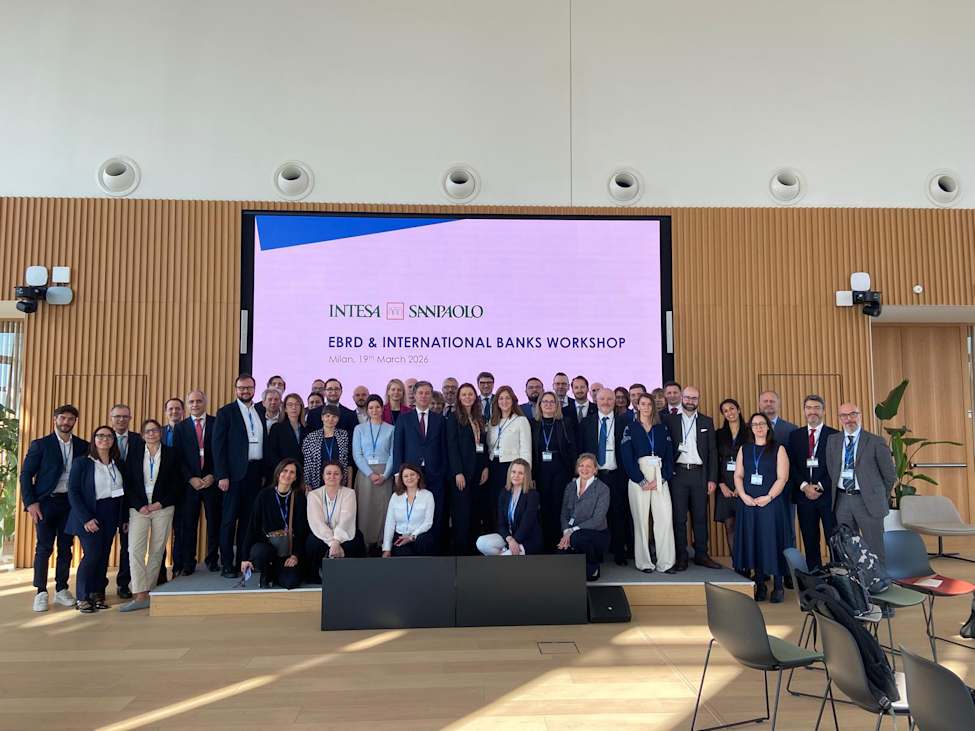
EBRD & International Banks Division Workshop: Bridging the gap between available financial solutions and market demand
21.04.2026
A framework designed to translate strategic alignment into practical collaboration and concrete follow-up initiatives
Not just an exchange of high-level views, but to compare regional realities, identify gaps between available instruments and real market needs, explore areas for improvement and innovation, and ultimately define actionable next steps. That was the ambition behind the workshop, the first initiative of this kind within the International Banks Division.
The event marked a milestone in the relationship between Intesa Sanpaolo and European Bank for Reconstruction and Development (EBRD), who met in person for the first time in a single event all the respective peers from all the Banks in the International Banks Division (IBD).
The event was managed and coordinated, within IBD Corporate, SME Small Business, by IBD IFI & Supranationals, part of the IBD Cross-Country Initiatives led by Laurent Truflandier who recently joined the IBD:
Laurent Truflandier, Head of IBD Cross-Country Initiatives
“This event reflects the mission of the IBD IFI & Supranationals team whose activities range from the origination and negotiation of institutional frameworks to the operational rollout of IFI-backed facilities, coordinating and supporting the Banks in aligning their commercial initiatives with Group’s priorities. The main goal of the team and of this workshop is to further enlarge the cooperation between our Banks and IFIs like EBRD. I’m therefore confident that our today’s discussions will convert soon into new projects, such as: new funding to local economies; risk-sharing, co-financing and guarantees initiatives to support our business and customers at better conditions.”
The Unit planned the agenda under the key word: not just discussion, but action-oriented cooperation, with the ambition to align strategic priorities, strengthen cooperation and leave the room with concrete, actionable next steps.
A defining feature of the workshop was its strong focus on execution. Beyond strategic alignment, the sessions enabled the identification of concrete follow-up actions, including deeper technical engagement on risk-sharing solutions, capital optimization tools and emerging innovation topics.
From Coordination to Co-Creation
The workshop highlighted a shift in approach: from coordination to true co-creation. Participants from both the Banks and EBRD were selected based on their direct operational involvement with financial instruments, guarantees, ESG solutions, capital markets and digital innovation, ensuring discussions were firmly anchored in business reality.
This bottom-up methodology, promoted by the IBD IFI & Supranationals Unit, enabled a more open and pragmatic exchange, where operational insights complemented strategic perspectives. The agenda itself reflected this philosophy, having been built on a structured listening exercise conducted across International Banks in 2025. The strong alignment in feedback across countries confirmed both the relevance of the identified priorities and the Division’s ability to consolidate diverse market needs into a coherent framework.
Addressing Market Realities Across the Network
Through three rounds of parallel roundtables, the workshop facilitated an in-depth discussion across EU and non-EU geographies, reflecting the diversity and complexity of the Group’s international footprint.
A key message emerging from the discussions was the need to bridge the gap between available financial solutions and actual market demand. While liquidity is generally present, the real challenge lies in optimizing balance sheets, improving capital efficiency and ensuring that products are aligned with local market realities.
Participants emphasized that each country presents its own structural characteristics—ranging from regulatory environments to market maturity requiring tailored approaches. In this context, the ability to combine global expertise with deep local knowledge emerged as a critical success factor.
Driving Growth Through Risk-Sharing and ESG Solutions
A central theme of the workshop was how to support sustainable growth while managing risk and capital constraints.
Discussions confirmed the strategic relevance of EBRD’s Risk Sharing Framework, which enables partner Banks to expand lending, particularly to SMEs but also to other priority sectors (including green finance, social inclusion, affordable housing and human capital development), through funded and unfunded risk-sharing solutions, including portfolio guarantees and capital relief mechanisms. These tools allow for more efficient use of balance sheets, unlocking additional lending capacity without increasing risk exposure.
At the same time, participants openly addressed practical challenges, including operational complexity, regulatory treatment and the need for simplification. This constructive exchange helped identify areas for further optimization and potential enhancements in the use of existing instruments.
A Collective Effort for the Future
All in all, far from being a standalone event, the Milan workshop witnesses a strong inter-divisional effort and represents a key step in strengthening direct engagement between the Banks and a key partner such as EBRD.
Giuseppe Ferraro Head of IBD Corporate SME Small Business
“This workshop reflects our commitment to moving from strategic dialogue to concrete action. By bringing together colleagues from across our international network and strengthening our cooperation with EBRD, we are fostering a more integrated and operational approach to addressing market needs.
In this context, we aim to further strengthen our role as an enabler, connecting international financial institutions with local markets. Our objective is to translate these shared priorities into practical solutions that directly support our SME and Corporate clients in achieving sustainable growth and long-term impact across all our geographies.”
European Bank for Reconstruction and Development
The European Bank for Reconstruction and Development (EBRD) was originally established to help build a new post-Cold War era in central and eastern Europe, but because of its success has now expanded operations into three continents. The Bank has invested more than €220 billion in over 7,800 projects.
The EBRD is committed to furthering progress towards ‘market-oriented economies and the promotion of private and entrepreneurial initiative’. This has been its guiding principle since its creation at the beginning of the 1990s
Safeguarding the environment and a commitment to sustainable energy have also always been central to the EBRD’s activity. A commitment to promote ‘environmentally sound and sustainable development’ was made explicit at its founding.